All-on-4 vs All-on-6 Dental Implants: Which is Best for You?


Replacing all missing teeth with fixed dental implants is one of the most significant decisions a patient can make. Two of the most established solutions today are All-on-4 and All-on-6 dental implants. Both approaches can restore a permanent, natural-looking smile often within a short timeframe. Yet despite their similar names, they are not interchangeable solutions, and choosing the right one depends on a couple of important factors such as anatomy, bone quality and the experience of the dentist.
One of our patients, Darren, a 65-year-old man from Manchester, contacted us while searching for the right dentist. He had lived with 11 missing teeth for over seven years, a condition that gradually led to a significant loss of jawbone density. Like many patients considering full mouth dental implants, Darren had some concerns and questions throughout his implant journey. His experience reminded us just how overwhelming the decision-making process is when it comes to full mouth solutions.
Darren’s story also reinforced the importance of providing clear, honest, and medically sound guidance to patients seeking reliable dental implant treatments. This is exactly what inspired us to create this comprehensive guide, to help you understand your options, evaluate what truly matters, and make informed decisions with confidence.
This article explains the differences clearly, highlights what really matters for patients, and shows how Qunomedical helps patients find the right doctor.
What Exactly Are All-on-4 and All-on-6?
Both All-on-4 and All-on-6 are full-mouth implant treatments. They replace all teeth in the upper or lower jaw using a fixed bridge supported by dental implants.
All-on-4 uses four implants per jaw. Two implants are placed vertically in the front, and two are placed at an angle in the back to maximize contact with the bone.
All-on-6 uses six implants per jaw. This provides additional stability and distributes the pressure of biting and chewing more evenly across the jaw.
The implants act as anchors for a non-removable prosthetic bridge, allowing patients to eat, speak, and smile with confidence without removable dentures. While the concept is simple, the execution is highly technical and requires careful planning.
Dental implant treatment is usually done in two stages. At the first appointment, the dentist places the implants into the jawbone; these act like artificial tooth roots and are left under the gums to heal. After a waiting period of about 4–6 months, the second appointment takes place. This healing period is necessary because the bone needs time to grow around the implants and lock them firmly in place, creating a strong foundation that can safely hold the new permanent teeth for many years.
Because making the right choice for full mouth dental implants can feel overwhelming, we turned to expert guidance. We asked Dr. Ali Kılıç from DentaPoint Dental Clinic, one of our most trusted and experienced dentists, to answer the questions patients ask most often.
Ask Dr. Ali Kilic
From a clinical perspective, when do you recommend All-on-4 versus All-on-6 dental implants ?
"All-on-4 is usually recommended for elderly patients or those with a smaller jaw structure. All-on-6 is more suitable for younger patients with early bone loss and a wider jaw."
All-on-4 vs All-on-6
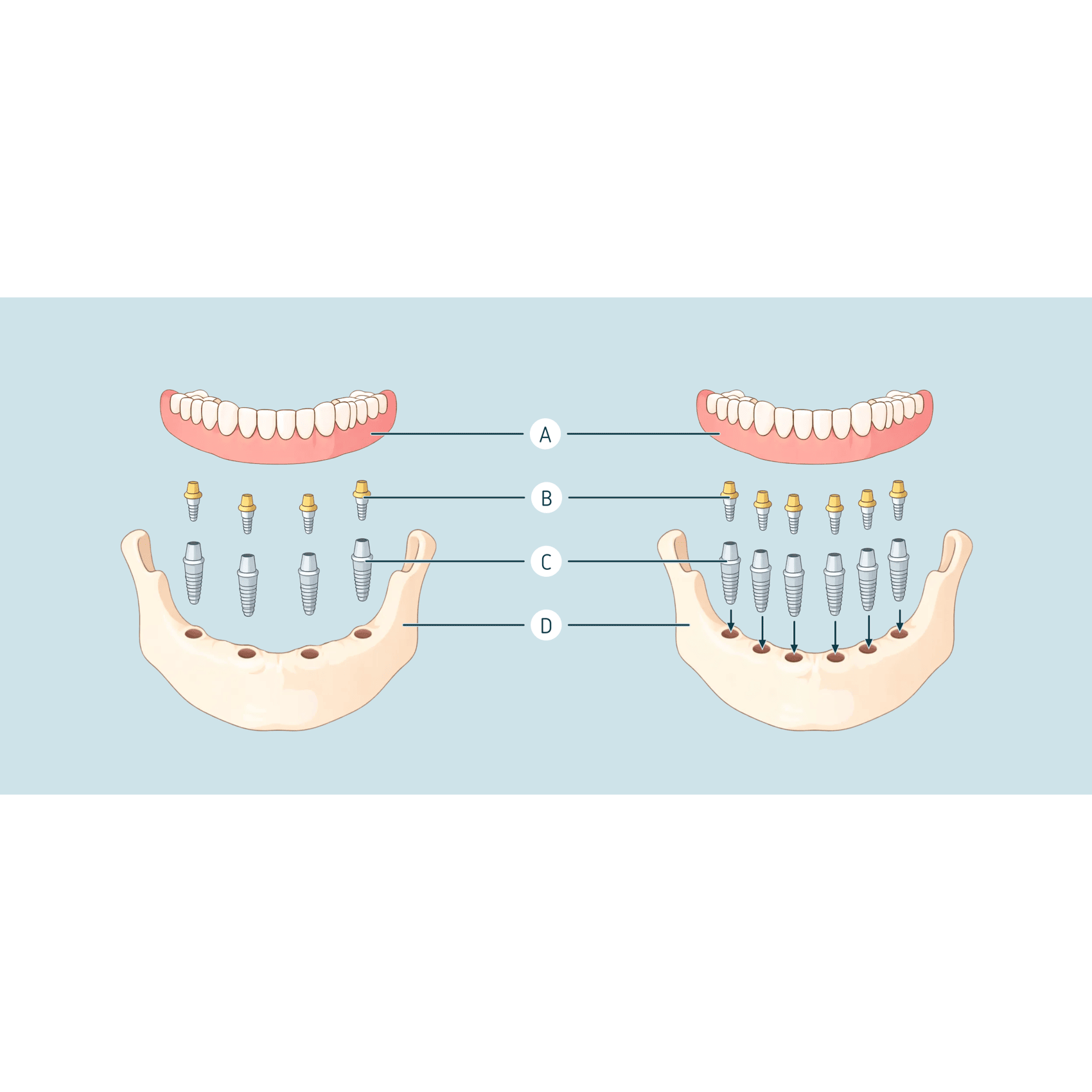
This illustration explains the structure of a full-arch implant restoration.
A: represents the fixed prosthetic teeth
B: the connector pieces (abutments)
C: the dental implants placed in the jaw
D: the jawbone that supports the entire system.
In the first image, the bridge (A) is supported by four implants (All-on-4), while in the second image it is supported by six implants (All-on-6), connected through the abutments (B).
It’s common to think that more implants automatically mean better results. But in reality, what’s appropriate for you matters more than the number. Let’s go over the most important factors to consider.
Bone Quality, Load Distribution, and Long-Term Outcomes
One of the most important differences between All-on-4 and All-on-6 is how biting pressure is distributed into the jawbone.
With All-on-4, implants are angled and optimized to work with limited bone.This approach has helped many patients avoid additional procedures such as bone grafting.
With All-on-6, forces are distributed across more implants, reducing stress per implant.This can support long-term bone stability, particularly for patients who grind their teeth, have strong bite forces, or want an extra margin of support over time.
Both approaches can deliver excellent long-term results when planned and executed correctly.
Surgery, Comfort, and Recovery
All-on-4 procedures are generally shorter, while All-on-6 may involve slightly longer surgical time due to the additional implants. Recovery timelines are similar for both options, though swelling and discomfort can vary from person to person.
Ask Dr. Ali Kilic
From a patient comfort and recovery perspective, how do you compare All-on-4 and All-on-6 solutions?
"The post-operative process is very similar for both treatments. Mild swelling, pain, and bruising can occur and are considered normal. Some discomfort may occur for a few days after the procedure which is well controlled with prescribed medications."
Are these procedures painful?
"The patient does not feel pain during the surgical procedures because it is performed under local anesthesia. However, after the anesthesia wears off, mild to moderate pain may be experienced for a few days. To minimize discomfort, appropriate medication is prescribed."
How long will the solution last ?
"These treatments are designed to last a lifetime. However, if the patient has systemic diseases or very poor oral hygiene, the longevity of the treatment may change and lifetime solution cannot be guaranteed."
All-on-4 vs All-on-6 in a nutshell
| Criterias | AO4 | AO6 |
|---|---|---|
| Number of implants | 4 | 6 |
| Surgical Complexity | Lower | Higher |
| Bone requirement | Suitable for moderate bone loss | Requires good bone density |
| Cost | 7500€ (Both Jaws) | 9500€ (Both Jaws) |
| Stability | Adequate stability for moderate bite force | Increased stability by balanced bite force; suitable for patients with strong bite or bruxism history |
| Recovery | Faster due to less number of implants | Longer due to more number of implants |
| Longevity | Durable, requires regular maintenance | Higher durability, lower maintenance |
Full Mouth Dental Implants Instead of Single Implants?
All-on-4 and All-on-6 dental implant treatments are not typically recommended for patients missing only a few teeth while the remaining natural teeth are healthy; in these cases, single dental implants or implant-supported bridges are usually the more conservative and appropriate solutions, allowing existing teeth to be preserved. These full-arch implant systems are primarily considered for patients who have lost most or all of their teeth, or whose remaining teeth are severely damaged due to advanced decay, fractures, gum disease, or significant bone loss, making them unsuitable for long-term function. In such situations, All-on-4 or All-on-6 provides a full mouth dental implant solution that replaces all teeth with a fixed, non-removable prosthesis, offering improved stability, chewing function, and aesthetics compared to traditional dentures.
Ask Dr. Ali Kilic
When You Would Say “No” for an All-on-4 and All-on-6 solution ?
"All-on-Four is not recommended for very young patients, patients with advanced bone loss, insufficient bone height (minimum 12 mm required), or a very wide jaw arch.
All-on-Six is generally not recommended for patients with severe bone loss; in such cases, zygomatic implants may be a better option."
Why Choosing the Right Doctor Matters More Than Choosing All-on-4 or All-on-6
Two patients with similar X-rays can receive different recommendations from equally qualified doctors, and both may be correct. That’s why Qunomedical does not promote a single clinic, country, or treatment philosophy.
Instead, Qunomedical helps patients:
Compare multiple experienced implant doctors
Access clinics across different countries
Receive independent medical opinions
Understand why recommendations differ
Make decisions based on medical fit
Qunomedical is about helping patients find the right solution with the right doctor.
The Conclusion: Which One Is for You?
The only way to be 100% certain is through diagnostic imaging, ideally X-rays, along with a consultation with a dental professional. All of our partners use digital imaging to map your bone structure and determine the configuration that will provide the most comfortable and long-lasting result. Your journey begins with a call with one of our treatment specialists to review your options, followed by a consultation with your preferred dentist.